
'Wicked Problems' and Denial of our Entanglement within Secondary Schools
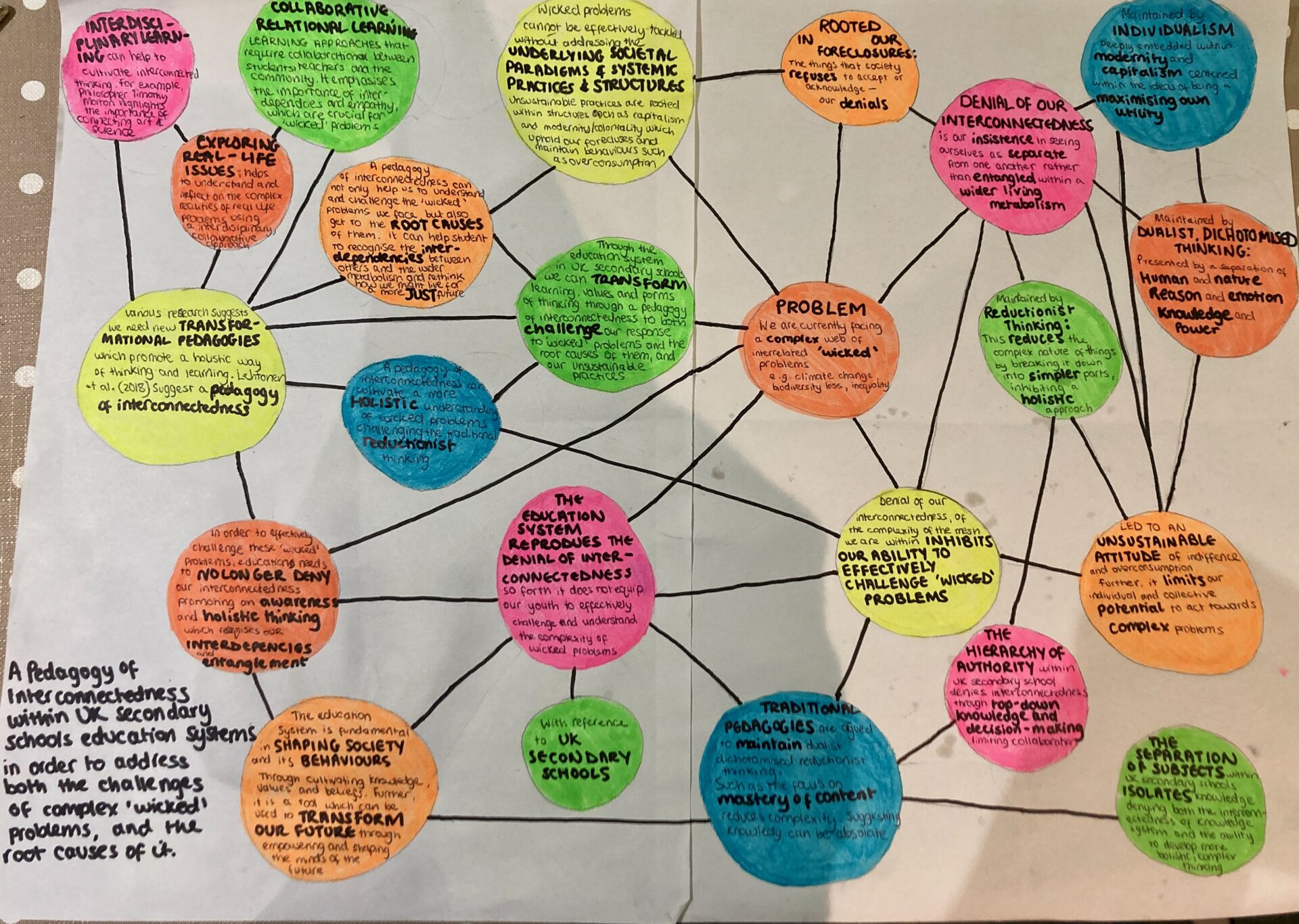
Through this mindmap, I demonstrate how the complexity and interconnective nature of the 'wicked' problems we face today demands more transformative and holistic way of learning, which recognises the interconnectedness of the entirely of the wider living metabolism of our planet. Using the work from various authors, including Stein, Andreotti and Lehtonen, I consider how the UK education system within secondary schools maintains dualist, dichotomised, reductionist thinking, which in turns implicates our ability as a society to not only effectively challenge 'wicked' problems, but also ability to recognise and question the root of the underlying structures which have enabled these 'wicked' problems to come about in the first place. I use Lehtonen's concept of a pedagogy of interconnectedness, to consider what a more transformative approach to learning within the UK secondary school system could look like. The structure of the problem is laid out within an interconnected mindmap, to demonstrate the interconnectedness within 'wicked' problems and its associated denials. It can also be a potential tool for learning, similar mindmaps could be used within lessons to look at the interconnectedness when addressing real-life problems in class.
Reference list
Andreotti, V. 2016. The Educational Challenges of Imagining the World Differently. Canadian Journal of Development Studies. 37(1), pp.101–112.
Lehtonen, A., Salonen, A., Cantell, H. and Riuttanen, L. 2018. A Pedagogy of Interconnectedness for Encountering Climate Change as a Wicked Sustainability Problem. Journal of Cleaner Production. 199, pp.860–867.
Morton, T. 2010. The Ecological Thought. Cambridge; London: Harvard University Press.
National Association for Environmental Education (NAEE) 2021. The Urgency of Climate Change Education. UK NAEE. [Online]. [Accessed 12 October 2024]. Available from: https://naee.org.uk/the-urgency-of-climate-change-education/.
Sover, K. and Walsh, E.M. 2022. Introduction: Climate Change Education Must Be Education for Justice In: Justice and Equity in Climate Change Education [Online]. Routledge, pp.1–38. [Accessed 23 October 2024]. Available from: https://www.taylorfrancis.com/reader/read-online/b144b13f-1b76-4125-b345-61ea56b82ce8/chapter/pdf?context=ubx.
Stein, S., Andreotti, V., Suša, R., Ahenakew, C. and Čajková, T. 2020. From ‘Education for Sustainable Development’ to ‘Education for the End of the World as We Know It’. Educational Philosophy and Theory. 54(3), pp.1–14.
University of Reading 2024. National Climate Education Action Plan [Online]. [Accessed 20 October 2024]. Available from: https://www.reading.ac.uk/planet/-/media/project/uor-main/uor-campaign/climate-for-change/climate-education-summit/climateeducationsummit-actionplan.pdf?la=en&hash=70A9DA27CDA84F375723D8C91F45B12F.